
Background
Many fabrication companies, such as R&H Innovations, continue to rely on traditional, manual processes that involve multiple steps, including measuring, marking, cutting, drilling, and finishing.
These methods create several operational challenges:
-
Slow, step-by-step production workflows
-
High dependency on manual labour and operator skill
-
Increased likelihood of human error
-
Bottlenecks caused by material handling between processes
- Long lead times and limited scalability
These inefficiencies prevent manufacturers from meeting increasing production demands and maintaining consistent quality.
FactorySmart identified these limitations and introduced an integrated laser automation solution designed to consolidate processes, reduce manual intervention, and improve overall production performance.
Key challenges included:
-
Slower welding processes due to multi-step operations
-
High heat input leading to material distortion
-
Inconsistent weld quality depending on operator skill
-
Frequent need for filler materials and post-processing
- Limited precision when working on detailed or thin components
Although functional, these methods were restricting production efficiency, increasing labour intensity, and impacting overall product consistency.
To address these challenges, FactorySmart introduced laser welding technology, focusing on precision, speed, and process simplification.
The Demonstration
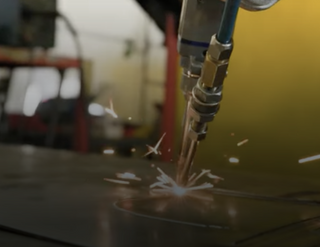
A live demonstration showcased how laser welding operates in a production setting.
The demonstration focused on:
-
Precision and control of the laser beam
-
Speed of the welding process
-
Heat concentration and material impact
- Overall weld quality and finish
During the demo:
-
The laser produced a highly concentrated heat source, melting material instantly at the joint
-
The process was smooth, continuous, and easy to control
-
Weld seams appeared clean, narrow, and highly precise
- Minimal heat spread reduced distortion in surrounding material
A key takeaway:
Laser welding delivers controlled energy in a very small area, enabling faster, cleaner, and more precise welds
Trial Results:
1. Production Efficiency
| Laser Welding: | Traditional Welding: |
|
|
Outcome: Significant improvement in production speed and workflow efficiency, as laser welding can complete joints in a fraction of the time
2. Weld Quality & Precision
| Laser Welding: | Traditional Welding: |
|
|
Outcome: Higher-quality welds with superior precision and repeatability
3. Heat Control & Material Integrity
| Laser Welding: | Traditional Welding: |
|
|
Outcome: Better dimensional accuracy and preservation of material properties
4. Post-Processing Reduction
| Laser Welding: | Traditional Welding: |
|
|
Outcome: Reduced secondary operations and labour time
5. Ease of Operation
The demonstration highlighted simplicity in operation:
- The process is highly controllable via system parameters
- Less manual intervention required
- Reduced reliance on highly skilled welders
Outcome:
Faster onboarding and improved workforce flexibility
6. Process Simplicity & Automation Potential
| Laser Welding: | Traditional Welding: |
|
|
Outcome: A more scalable and repeatable manufacturing process
Winning Factors
Speed & Throughput
-
Rapid melting and welding cycles
- Increased production capacity
Precision & Quality
-
Clean, narrow, high-quality welds
- Excellent repeatability
Minimal Heat Impact
-
Reduced distortion
- Smaller heat-affected zone
Reduced Post-Processing
- Little to no grinding or finishing
Ease of Use & Automation
-
Lower skill dependency
- Compatible with automated systems
Bottom Line
Based on the demonstration, adopting laser welding enables R&H to:
-
Increase production speed and efficiency
-
Achieve higher precision and consistency
-
Minimize heat-related defects and distortion
-
Reduce post-processing and labour costs
- Improve scalability through automation
Factory Smart’s solution shows that laser welding is not just an incremental improvement - it is a fundamental shift toward faster, cleaner, and more controlled manufacturing.