


Heavy-duty rust & paint removal
FactorySmart supplies the DMK Laser Cleaning Series to heavy industrial operations across South Africa - fabrication, automotive, aerospace, and mining. Three configurations are available: the DMK 200, DMK 300, and DMK 500, each powered by a pulsed nanosecond laser source matched to a different throughput requirement.
The system uses nitrogen or compressed air as an assist gas and requires minimal wear parts - no blast media, no chemical consumables. Running cost is a fraction of equivalent abrasive or chemical cleaning processes.
Precision in every pass
We specialise in handheld laser cleaning solutions, evaluating each application based on surface type, contamination level, material sensitivity, and production workflow. Our solutions combine controlled laser parameters, ergonomic handling, and seamless integration into existing processes to remove rust, coatings, and residues with accuracy - reducing surface damage, minimising consumables, and maximising operational efficiency.
One Series. Three Power Levels.
FactorySmart supplies the DMK Laser Cleaning Series to heavy industrial operations across South Africa - fabrication, automotive, aerospace, and mining. Three configurations are available: the DMK 200, DMK 300, and DMK 500, each powered by a pulsed nanosecond laser source matched to a different throughput requirement.
The system uses nitrogen or compressed air as an assist gas and requires minimal wear parts - no blast media, no chemical consumables. Running cost is a fraction of equivalent abrasive or chemical cleaning processes.
| DMK 200 | DMK 300 | DMK 500 | |
|---|---|---|---|
| Best for | Light precision cleaning | Medium-duty industrial use | Heavy-duty rust & paint removal |
| Laser source | Pulsed nanosecond (Maxphotonics) | Pulsed nanosecond (Maxphotonics) | Pulsed nanosecond (500 W) |
| Scanning optics | 2D Scanner | 2D Scanner | 2D high-speed scanner (max 116 mm) |
| Cooling | Air-cooled | Air-cooled | Air-cooled |
| User interface | Touchscreen, safety interface, distance sensor | Touchscreen, safety interface, distance sensor | Touchscreen, safety interface, distance sensor |
| Dimensions (mm) | 610 × 265 × 878 | 630 × 370 × 540 | 770 × 428.5 × 656 |
| Weight | 25 kg | 50 kg | 56 kg |
| Laser class | Class 4 - PPE mandatory | Class 4 - PPE mandatory | Class 4 - PPE mandatory |
The Challenge:
When Surface Preparation Becomes a Bottleneck
Every downstream process - welding, coating, NDT inspection, precision machining - depends on a clean, uncontaminated surface. Rust, mill scale, residual paint, and processing lubricants cause weld defects, coating delamination, and rejected inspections.
Abrasive blasting embeds media in porous substrates, is incompatible with tight tolerances, and requires blast booth infrastructure. Chemical stripping generates regulated waste and adds rinse steps. Neither scales well for mixed substrate environments or maintenance operations requiring portability.
How Pulsed Nanosecond Laser Cleaning Works
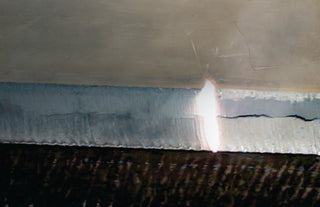
The DMK generates very short laser pulses in the nanosecond range. Concentrating energy into such a short time span produces extremely high peak power without continuous heat input. The contaminant layer — rust, oxide, paint, scale — absorbs this energy at a higher rate than the base substrate beneath it, vaporising without transmitting damaging heat to the parent material.
The beam is delivered through a 2D galvanometric scanner. The DMK 200 and 300 use a standard 2D scanner; the DMK 500 uses a high-speed 2D scanner with up to 116 mm deflection and a distance sensor for automatic focal control on curved or uneven surfaces. Nitrogen or compressed air assist gas is used during operation to clear ablated material from the cleaning zone.
No Substrate Deformation
Non-contact, selective energy absorption means the DMK is safe on thin-wall sections, precision-machined surfaces, and heat-sensitive alloys — substrates where abrasive blasting is damaging or dimensionally unacceptable.
Significantly Lower Running Cost
Laser cleaning requires nitrogen or compressed air as an assist gas and minimal wear parts — no blast media, no solvents, no chemical disposal. Compared to abrasive blasting or chemical stripping, the reduction in consumable, waste management, and compliance costs is substantial. All three DMK models are air-cooled, with no water-cooling infrastructure required.
Controlled, Repeatable Output
Scan parameters are set digitally and reproduced across operators and shifts — compatible with ISO 9001 quality systems and surface preparation standards including AWS D1.1, EN 1011, and ISO 8501.
Portable — Positioned at the Work
All models are self-contained on wheeled chassis. The DMK 200 at 25 kg suits precision workshop applications. The DMK 300 and 500 handle mid-range and high-volume requirements while remaining mobile enough to bring to the workpiece.
Class 4 Laser — Safety Requirements
All DMK models are Class 4 lasers under IEC 60825-1. Direct beam, specular reflection, and close-range diffuse reflection can cause irreversible eye and skin damage. Laser safety eyewear rated for the operating wavelength is mandatory. FactorySmart provides safety guidance at commissioning.
Laser Cleaning vs Traditional Methods
| CRITERION | DMK LASER CLEANING | TRADITIONAL METHODS |
|---|---|---|
| Substrate contact | Non-contact — no mechanical stress | Contact — risk of deformation |
| Consumables | Limited — nitrogen or compressed air; minimal wear parts | Limited — nitrogen or compressed air; minimal wear parts |
| Surface after treatment | Ready for welding, coating, or inspection | May require secondary cleaning or rinse |
| Heat input to substrate | Negligible — nanosecond pulse delivery | Grit blast: none; thermal methods: significant |
| Precision | Digitally controlled — reproducible per shift | Variable — operator-dependent |
| Operator exposure | Class 4 laser PPE; no chemical fumes | Chemical fumes, dust, and noise |
| Portability | Self-contained wheeled unit; 25–56 kg by model | Fixed or semi-fixed installations typical |
| Waste stream | Dry particulate — easy extraction | Liquid effluent, chemical disposal, blast containment |
| Running cost | Significantly lower — gas/air and electricity only | Ongoing consumable procurement and disposal |
Industry Applications
Heavy Fabrication and Structural Steel
Pre-weld surface preparation requires removal of mill scale, rust, and coating from the joint zone before welding. The DMK is applied directly on the fabrication floor — no blast booth, no media embedment, no contamination of adjacent surfaces. Compliant with ISO 5817 and AWS D1.1 pre-weld cleanliness requirements.
Automotive and Transport
For sub-assemblies, prototypes, and maintenance rework, laser cleaning replaces chemical degreasing without rinse cycles or chemical residue. The DMK 200 suits precision component cleaning; the DMK 500 addresses higher-volume rust removal from frame members and chassis rails.
Aerospace and Defence
The pulsed nanosecond process is parameter-controlled and traceable — qualifiable within AS9100 and NADCAP-accredited manufacturing plans. For MRO, the portable DMK enables in-situ surface restoration without component removal, meeting MIL-spec traceability requirements.
Mining and Resources
Persistent corrosion on structural members, pipework, and pressure vessels in mining environments is addressed directly by the DMK's wheeled chassis — operators work on installed plant without transporting components. Pre-NDT surface preparation (magnetic particle, dye penetrant) is a direct application — no media embedment risk.
General Industrial Maintenance
Tooling maintenance, mould cleaning, conveyor component restoration, and precision part degreasing — tasks currently handled by wire brushing or grinding — are addressed by the DMK 200 in workshop environments, with the DMK 300 and 500 covering higher-volume maintenance requirements.
Technical Specifications - DMK 200 / 300 / 500
| PARAMETER | DMK 200 | DMK 300 | DMK 500 |
|---|---|---|---|
| Laser source | Pulsed nanosecond (Maxphotonics) | MediuPulsed nanosecond (Maxphotonics) | Pulsed nanosecond (air-cooled, 500 W) |
| Scanning optics | 2D Scanner | 2D Scanner | 2D high-speed scanner |
| Max scan deflection | 110mm | 110mm | 116mm |
| Cooling | Air-cooled | Air-cooled | Air-cooled |
| Assist gas | Nitrogen or compressed air (≥ 0.4 MPa, dry and filtered) | Nitrogen or compressed air (≥ 0.4 MPa, dry and filtered) | Nitrogen or compressed air (≥ 0.4 MPa, dry and filtered) |
| POWER SUPPLY | 230 V | 230 V | 230 V |
|---|---|---|---|
| User interface | Touchscreen | Touchscreen | Touchscreen, safety interface, distance sensor |
| Compatible materials | All metallic materials | All metallic materials | All metallic materials |
| Primary applications | Weld seam cleaning, small components | Weld seam cleaning, small components | Rust and paint removal, weld seam cleaning |
| Dimensions (mm) | 610 × 265 × 878 | 630 × 370 × 540 | 770 × 428.5 × 656 |
| Weight | 25kg | 50kg | 56kg |
| Laser classification | Class 4 | Class 4 | Class 4 |
| Consumables | Limited — nitrogen or compressed air, minor wear parts | Limited — nitrogen or compressed air, minor wear parts | Limited — nitrogen or compressed air, minor wear parts |
FREQUENTLY ASKED QUESTIONS
Find answers to common questions

Discuss Your Application With Our Team
Bring us your cleaning problem. We will identify the right configuration and assist gas setup for your substrate, contamination type, and production volume.
FactorySmart supports production managers, maintenance engineers, and procurement leads across South African heavy industry. Based in Kempton Park, Gauteng.