
Background
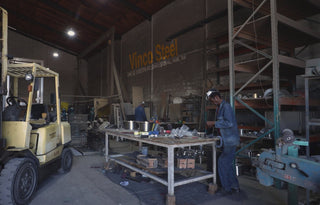
Vinco Steel manufactures custom stainless steel drainage systems and sanitary products for the food, wine, beverage, meat processing, fruit packing, and general processing industries.
As demand increased, the company faced several operational challenges:
- Insufficient production capacity to meet required volumes
- Slow fabrication processes limiting throughput
- High dependence on skilled welders
- Inconsistent quality caused by manual welding methods
- Excessive manufacturing costs impacting profitability
- Product distortion affecting accuracy and final quality
These challenges had become so significant that the business was operating at a loss.
Recognising that traditional welding methods were limiting both productivity and profitability, Vinco Steel began investigating laser welding technology as a potential solution.
After contacting FactorySmart, the company implemented a laser welding system to improve production speed, consistency, and overall manufacturing efficiency.
The Demonstration
FactorySmart worked closely with Vinco Steel from the initial enquiry through installation and commissioning of the laser welding system.
The evaluation focused on:
- Increasing production output
- Improving weld consistency
- Reducing dependence on specialised welding skills
- Lowering manufacturing costs
- Improving product quality and accuracy
During implementation:
- Operators quickly adapted to the new technology
- Welding became significantly faster than traditional TIG welding
- Weld quality became highly consistent and repeatable
- Distortion was dramatically reduced
- Manufacturing costs decreased substantially
A Key Takeaway
Laser welding transformed welding from a highly skilled manual process into a repeatable, operator-driven manufacturing process.
Trial Results:
1. Production Capacity & Speed
| FactorySmart – Laser Welding | Vinco Steel – Traditional TIG Welding |
|
|
Outcome: Internal testing showed welding speeds exceeding eight times the output of conventional TIG welding.
2. Weld Quality & Consistency
| Laser Welding | Traditional Welding |
|
|
Outcome: Improved repeatability and superior weld quality across all production runs.
3. Reduced Skill Dependency
| Laser Welding | Traditional Welding |
|
|
Outcome: Reduced reliance on specialised welding skills while maintaining quality standards.
4. Cost Reduction
A major benefit highlighted by Vinco Steel was the reduction in manufacturing costs.
- Faster production cycles
- Lower labour input per component
- Improved productivity per operator
- Ability to manufacture products previously considered uneconomical
Outcome
Products could be manufactured at a fraction of the previous cost.
5. Product Quality & Distortion Control
| Laser Welding | Traditional Welding |
|
|
Outcome: Higher-quality finished products with improved accuracy and appearance..
Winning Factors
Production Speed
- More than 8× faster than previous TIG welding processes
- Increased manufacturing capacity
Consistency & Automation
- Machine-controlled welding
- Repeatable, high-quality results
Lower Manufacturing Costs
- Reduced labour requirements
- Improved production efficiency
Improved Product Quality
- More precise welds
- Reduced distortion
- Better finished products
Workforce Efficiency
- Reduced dependence on specialist welding skills
-
Easier operator training
Bottom Line
By implementing laser welding technology, Vinco Steel was able to:
- Increase production output dramatically
- Achieve welding speeds exceeding eight times traditional TIG welding
- Improve weld consistency and precision
- Reduce distortion and improve product quality
- Lower manufacturing costs significantly
- Reduce reliance on highly skilled welders
- Restore profitability and support business growth
Most importantly, the technology enabled Vinco Steel to transform a loss-making operation into a more productive, competitive, and sustainable manufacturing business.
FactorySmart's solution demonstrated that laser welding is more than a process improvement—it can fundamentally change the economics of manufacturing by increasing output, reducing costs, and delivering consistently superior quality.