
Background
LRJ Steel was relying on traditional welding methods that required significant manual effort and time to complete fabrication tasks.
These processes created several operational challenges:
- Slow welding speeds impacting overall production
- High dependency on skilled welders
- Inconsistent weld quality across operators
- Time-consuming grinding and finishing processes
- Bottlenecks caused by welding and post-processing
Although the existing methods were functional, they limited productivity, increased labor intensity, and reduced overall efficiency.
FactorySmart identified these constraints and proposed a live laser welding demonstration to showcase improvements in speed, quality, and ease of use.
The Demonstration
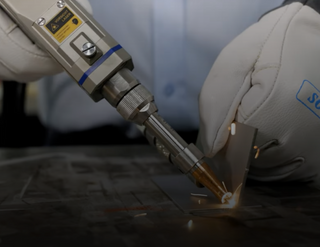
A live demonstration was conducted using a handheld laser welder to evaluate performance in a real-world fabrication environment.
The demonstration focused on:
- Welding speed and efficiency
- Ease of use for operators
- Weld quality and finish
- Reduction in post-processing
During the demonstration:
- The welding process was significantly faster than traditional methods
- Operators found the system easy to control and learn
- Welds were clean, precise, and uniform
- Minimal spatter and distortion were observed
A key takeaway:
Laser welding simplified the process while delivering faster, cleaner, and more consistent results
Trial Results:
1. Production Efficiency
| Factory Smart – Laser Welding | LRJ – CO₂ Welding |
|
|
Noticeable improvement in production speed and throughput
2. Weld Quality & Consistency
| Laser Welding | Traditional Welding |
|
|
Improved weld consistency and overall product quality
3. Post-Processing Reduction
| Laser Welding | Traditional Welding |
|
|
Significant reduction in secondary operations
4. Ease of Operation
A key theme in the testimonial was usability:
• Easy to learn and operate
• Reduced reliance on highly skilled welders
• Faster training and onboarding
Improved workforce flexibility
5. Heat Control & Material Integrity
| Laser Welding | Traditional Welding |
|
|
Better dimensional accuracy and reduced rework
Winning Factors
Speed & Throughput
- Faster welding cycles
- Increased production capacity
Precision & Quality
- Clean, consistent welds
- Reduced defects
Reduced Post-Processing
- Minimal grinding and finishing
Ease of Use
- Lower skill requirement
- Faster operator training
Improved Workflow
- Fewer bottlenecks
- Smoother production flow
Bottom Line
By adopting laser welding, LRJ Steel was able to:
- Increase production efficiency
- Improve weld consistency and quality
- Reduce reliance on highly skilled labor
- Minimize rework and finishing time
- Lower overall cost per part
FactorySmart’s solution demonstrates that laser welding is not just a faster alternative - it is a complete upgrade in efficiency, quality, and operational simplicity for modern fabrication.